

Everyday Mobility
Why You Lose Muscle After 50 (and the Walk That Slows It)
Somewhere in your fifties, the body quietly changes how it handles muscle. The same stairs, the same groceries, the same Saturday that used to leave you tired but intact now leaves something behind: a little less of the muscle you were spending. Muscle is being lost at roughly half a percent to one and a half percent per year between 50 and 80, and strength slides faster than size. But the process is not a verdict, and the single most underrated intervention is free: a walk.
Key Takeaways
- Muscle loss after 50 is ordinary biology, not a failure. Between 50 and 80, adults typically lose roughly 0.5 to 1.5 percent of muscle per year, and after 75 the measured rate runs about 0.6 to 1 percent per year in long-term studies.
- Strength declines faster than size. Power and quickness fade first, because fast-twitch fibers are the ones that thin out earliest, which is why the heavy door feels heavier before anything looks different.
- The fix has three parts, not one. Resistance work sends the building signal, protein supplies the material, and daily walking keeps the whole system insulin-sensitive and recruited.
- Creatine plus resistance training is the best-studied support. Multiple meta-analyses in older adults report greater strength and lean-tissue gains when creatine accompanies training compared with training alone.
- Walking is not a muscle-builder, and it does something else. It protects metabolic health, keeps slow-twitch fibers working, and is the habit most likely to still be happening in year ten.
What actually happens after 50
The biology is well mapped. Muscle protein synthesis, the process that repairs and rebuilds fibers after use, becomes less responsive to both food and exercise with age, a shift researchers call anabolic resistance. Hormonal signals that once supported maintenance drift lower. Fast-twitch fibers, the ones that generate quick force, become progressively denervated, and their workload gets silently reassigned to slower fibers. Meanwhile, the repair crews that clean up damaged fibers lose efficiency.
People eating on a smaller appetite can find the per-meal protein arithmetic in eating enough when hunger shrinks.
Longitudinal research puts numbers on the drift: people around 75 lose muscle at measured rates of about 0.64 to 0.7 percent per year in women and 0.8 to nearly 1 percent in men. Between 50 and 80, the commonly cited range is 0.5 to 1.5 percent per year. Scaled to a decade, that is a meaningful chunk of the engine that carries groceries, opens jars, catches a stumble before it becomes a fall.
The part most people miss is the order of events:
- Power fades before size. The strength to rise quickly from a chair or catch your balance narrows earlier than any visible change in the mirror.
- Sedentary periods accelerate everything. A few weeks of reduced activity at 60 costs more, and takes longer to recover, than the same layoff at 30, because the rebuilding response itself has slowed.
- Nerves thin out too. Losing the nerve connection to a fast fiber is what makes the fiber shrink, and that process responds to use like everything else.
Anabolic resistance: the age-related decline in how strongly muscle responds to the two signals that build it, protein from meals and the mechanical load of exercise. An older muscle needs a slightly bigger, more deliberate version of the same signals to get the same rebuilding response.
Why walking is the habit that slows the slide
Here is the honest part: walking is not resistance training, and it does not by itself rebuild the fast-twitch fibers that thin first. Anyone selling a stroll as a complete strength program is overselling. But walking protects the foundation that strength work stands on, and it is the part of the plan most likely to survive contact with real life.
- It keeps slow-twitch fibers recruited every single day. These are the endurance fibers of posture, standing, and strolling, and they are the ones walking actually maintains.
- It supports healthy glucose metabolism. Working muscle pulls in fuel and supports insulin sensitivity, and metabolic health is the background condition for muscle maintenance.
- It makes every other habit possible. Walking preserves the joints, circulation, and daily energy that resistance work requires, which is why a surgeon puts it first in the sequence, not last.
- It is durable. Gym habits lapse; a daily walk survives vacations, injuries, and motivation dips, and the best exercise program is overwhelmingly the one still being done in ten years.
The full plan is unglamorous: lift something heavy twice a week, eat enough protein at meals, and walk most days. The three parts cover the signal, the material, and the delivery system. Here is what that looks like as an actual week, with the walk dose spelled out.
1. The walk: 30 minutes, most days (22 to 30 minutes if brisk)
The dose that shows up in the research on walking and healthy aging is roughly 30 minutes a day, most days of the week, which at a moderate pace is about 1.5 to 2 miles. Brisk counts more than long: a pace where talking is possible but singing is not. Three 10-minute walks stack the same as one 30-minute walk, so the dose can be split across the day, and at 50-plus that split is often easier on joints and schedules. Dr. Warner’s after-dinner version is the one most people actually keep, because it anchors to a meal instead of to willpower.
2. The strength work: two sessions a week, 20 to 30 minutes each
This is the direct building signal, and it does not require a gym. Bodyweight squats to a chair, step-ups on stairs, wall push-ups, and a resistance band row cover the major muscle groups. Two sessions a week is the floor in the studies on resistance training in older adults; the movements should be slow enough to control on the way down, because the lowering phase is where much of the stimulus lives. Creatine’s research base sits on top of exactly this kind of consistent training, not on rest.
3. The protein: 25 to 40 grams per meal, spread across the day
Anabolic resistance means the same portion does less at 62 than at 32, so the practical move is distributing protein rather than concentrating it at dinner. A palm-sized piece of fish or chicken, eggs with breakfast, Greek yogurt, or beans and rice all land in range. For people whose appetite makes three solid meals difficult, protein-first eating, starting the plate with the protein before the sides, is the highest-leverage habit.
| Day of the week | Walk | Strength | Protein focus |
|---|---|---|---|
| Monday | 30 min brisk | Session 1 | Protein at breakfast |
| Tuesday | 30 min or 3 x 10 min | Rest | Normal day |
| Wednesday | 30 min brisk | Session 2 | Protein after training |
| Thursday | 30 min or 3 x 10 min | Rest | Normal day |
| Friday | 30 min brisk | Optional light session | Protein at breakfast |
| Saturday | Longer easy walk, 40 to 60 min | Rest | Weekend meals count too |
| Sunday | Easy walk, any length | Rest | Plan the week’s protein |
The best-studied support: creatine
Creatine is the most researched supplement in the muscle-maintenance conversation, and the trials in adults over 50 are consistent in direction. Systematic reviews report that creatine alongside resistance training produces greater gains in strength and lean tissue than training alone in older adults, with the effect strongest when training is actually happening.
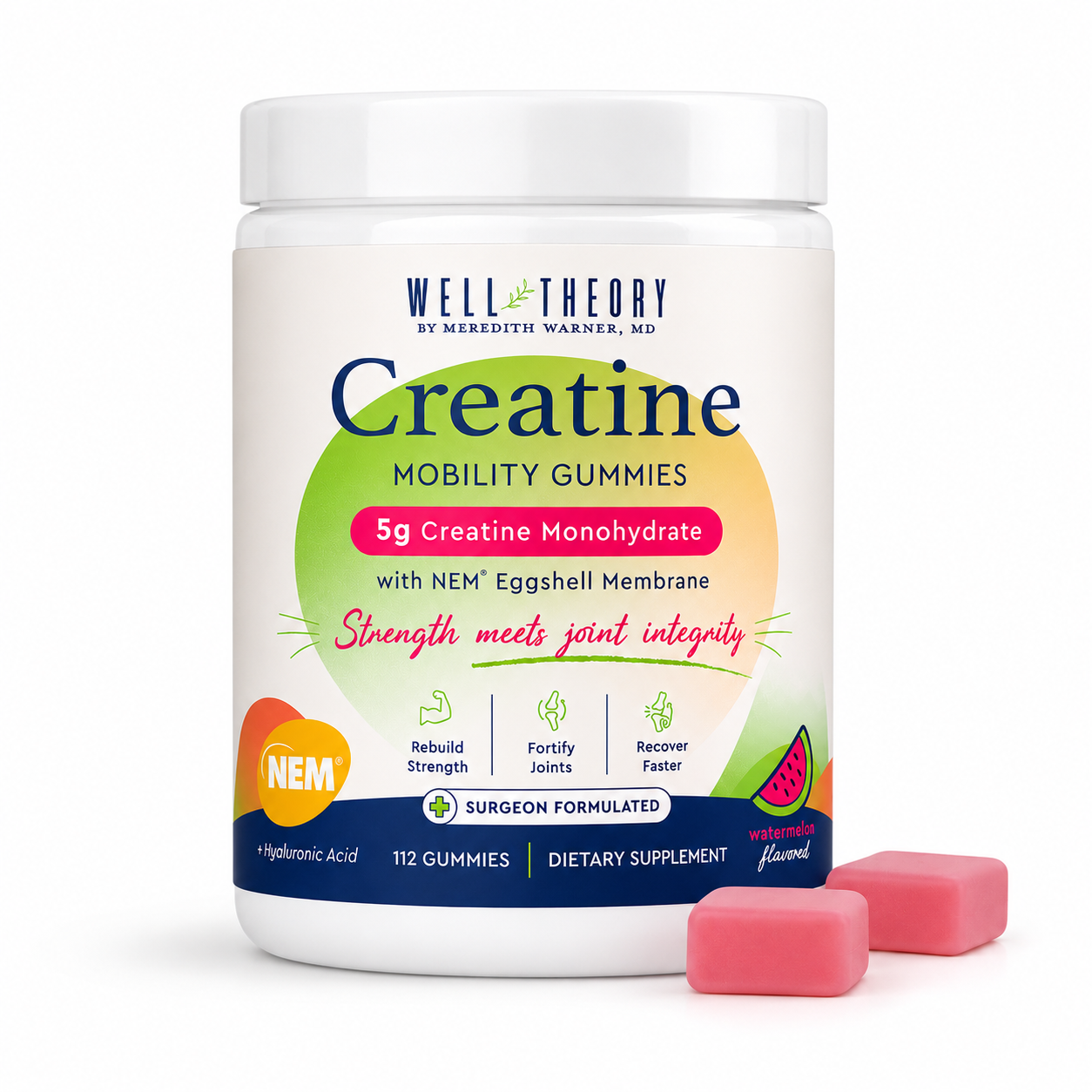
Dr. Warner formulated the Creatine + NEM Mobility Gummies for exactly this chapter of life: creatine to support muscle strength and recovery, paired with eggshell membrane for everyday joint comfort, so the training that protects muscle does not punish the joints doing it.
Protein is the other half of the sentence
Anabolic resistance means the same chicken breast does less at 62 than it did at 32. The practical answer is not complicated: spread protein across the day rather than concentrating it at dinner, and make sure each meal carries a real portion, roughly 25 to 40 grams, rather than a garnish. Older adults who maintain muscle are, in study after study, simply the ones eating enough of it. For people whose appetite makes that difficult, eating enough on a smaller appetite has its own playbook.
The Bottom Line
Muscle loss after 50 runs roughly half a percent to one and a half percent per year and accelerates with inactivity, but it responds to signals the way muscle always has. A daily walk keeps the system running, twice-weekly resistance work sends the building signal, protein supplies material, and creatine is the best-studied supplement support for the strength work. The earlier the habits start, the more muscle there is to work with, and the habits that win are the ones still standing in ten years. For readers past 60 looking for the easiest entry point, strength training can start with grip strength, using nothing more than a rubber ball and the grocery bags already in the car.
FAQ
How long does my daily walk need to be?
Roughly 30 minutes at a brisk pace, most days of the week, is the dose supported in research on walking and healthy aging, which works out to about 1.5 to 2 miles. Splitting it into three 10-minute walks works just as well, and for many people over 50 the split version is easier to keep.
Why does muscle loss happen after 50?
Muscle protein synthesis becomes less responsive to food and exercise, supportive hormonal signals drift lower, and fast-twitch fibers lose nerve connections. The combined effect is a typical loss of 0.5 to 1.5 percent of muscle per year between 50 and 80.
Can walking prevent muscle loss?
Walking maintains the slow-twitch endurance fibers used for posture and daily movement and supports healthy glucose metabolism, but it is not a substitute for resistance training, which provides the direct building stimulus. The strongest results come from walking plus twice-weekly strength work.
Does creatine work in adults over 50?
Multiple systematic reviews and meta-analyses report greater strength and lean-tissue gains when creatine is combined with resistance training in older adults, compared with training alone. The benefits are strongest when actual training is part of the routine.
How much protein do I need to maintain muscle after 50?
Research on older adults supports roughly 25 to 40 grams of protein per meal, spread across the day, to overcome the reduced responsiveness of aging muscle. Total daily intake matters more than any single meal.
How fast is muscle lost between 50 and 80?
Longitudinal studies commonly cite 0.5 to 1.5 percent per year across that age range, with measured rates around 75 of roughly 0.64 to 0.98 percent per year depending on sex. Inactivity accelerates the loss considerably.
