

Joint Comfort
What Helps With Stiff Joints? (and the Three Systems That Decide It)
What helps with stiff joints is whatever supports the three systems that run them: the fluid environment inside the joint, the cartilage that cushions it, and the muscles that protect it. Stiffness after a long drive, a movie, or a full night in bed is rarely one worn-out part asking for help. It is usually the whole system asking for better daily support, and that is good news, because all three systems answer to ordinary habits.
Key Takeaways
- Stiffness is a system, not a single part. The feeling usually traces to the joint’s fluid environment, its cartilage, and its muscle support working together, which is why single-ingredient answers so often disappoint.
- Movement feeds cartilage directly. Cartilage has no blood vessels of its own. The compression and release of walking pumps fluid through it, and laboratory studies measured large-molecule transport running 30 to 100 percent higher under that cycling than at rest.
- Appropriate exercise does not wear joints down. Systematic reviews of randomized trials report no evidence of cartilage wear from properly dosed exercise in adults, and some measures of joint health improved with training.
- Focused nutrients can fill the gaps food leaves. Creatine + NEM Mobility Gummies pair strength support with 500 mg of eggshell membrane, and Joint Health Multi combines turmeric, ginger, and PEA in one two-capsule serving.*
Why do joints feel stiff after sitting still?
The short answer is physics on top of biology. A healthy joint is lubricated by synovial fluid, and after a stretch of stillness that fluid settles and thins at the surfaces. Motion circulates it again, which is why the first steps after a long movie feel creaky and the twentieth feel fine.
- Stillness lets the joint settle. Movement thins and spreads the fluid again, which is why stiffness tends to ease as the morning gets going rather than the moment feet hit the floor.
- Cartilage plumps under gentle load. The first few slow movements drive fluid back into the tissue, preparing it before the day’s real demands arrive.
- Muscles set the tone. Warm, conditioned muscles absorb force before the joint feels it; cold or deconditioned ones pass more of every step straight through.
Synovial fluid: the joint’s built-in lubricant. Produced by the joint lining, it carries nutrients to cartilage, keeps the surfaces gliding, and circulates with movement. Stillness lets it settle, which is one reason a body feels stiffer after a long drive than after a walk.
What does the fluid environment have to do with comfort?
The body runs a repair crew that is supposed to arrive, finish the work, and leave. Inflammatory signaling is that crew, and a comfortable joint depends on the rhythm staying tidy: signals rise when tissue needs attention and resolve when the job is done. Daily habits shape how well that rhythm holds.
- Blood sugar swings leave a mark. In controlled research, a sharp rise in glucose measurably raised circulating inflammatory markers for roughly two hours afterward, even in healthy adults.
- Fat balance matters more than fat fear. Diets heavy in omega-6-rich processed oils and light in omega-3s are associated with higher circulating inflammatory markers, while higher EPA and DHA intake tracks lower.
- Colorful produce and fiber do quiet work. Berries, leafy greens, legumes, and nuts supply polyphenols and fiber that support the body’s normal inflammatory response.
The inflammatory rhythm is a lifestyle outcome, not a single meal or a single capsule. Food does the daily work, and a focused formula can round out the parts a normal week misses.
One formula for the inflammatory rhythm
Joint Health Multi brings 1,000 mg of turmeric root extract standardized to 950 mg curcuminoids, 1,000 mg of ginger root extract, and 300 mg of PEA into a two-capsule serving, with piperine included to support absorption.*
PEA has been studied for everyday comfort in double-blind randomized trials, and turmeric and ginger are two of the most researched botanicals on the joint-comfort shelf.* Dr. Warner formulated the serving to run alongside the food-first plate, not instead of it.

How does cartilage get its nutrition without a blood supply?
Cartilage is fed almost entirely by diffusion from the fluid around it, and it has a delivery mechanism hiding in plain sight: movement. Loading a joint compresses the tissue, and releasing the load lets it draw fresh fluid back in.
- Compression is the pump. In classic laboratory work using a simulated walking rhythm, the transport of large nutrient molecules through human cartilage ran 30 to 100 percent higher than in tissue left unloaded.
- Consistency beats intensity. Walking, cycling, swimming, bodyweight squats to a chair, step-ups, and resistance band work all create the compression-and-release cycle without excessive load.
- Exercise does not wear joints down. Reviews of randomized trials report no evidence of cartilage wear from appropriately dosed exercise, and some measures of cartilage health improved with training.
The second half of the story is material. Cartilage is built from collagen and glycosaminoglycans, and eggshell membrane carries a strikingly similar parts list: collagen, elastin, and glycosaminoglycans including chondroitin and hyaluronic acid.
In a two-week randomized trial, 500 mg of eggshell membrane per day kept a marker of cartilage turnover lower than placebo in healthy postmenopausal women following a stair-stepping regimen, with recovery from exercise-related stiffness responding within the first week. The trial used the exact branded ingredient and dose found in the gummies below.
The movement formula: strength plus raw materials
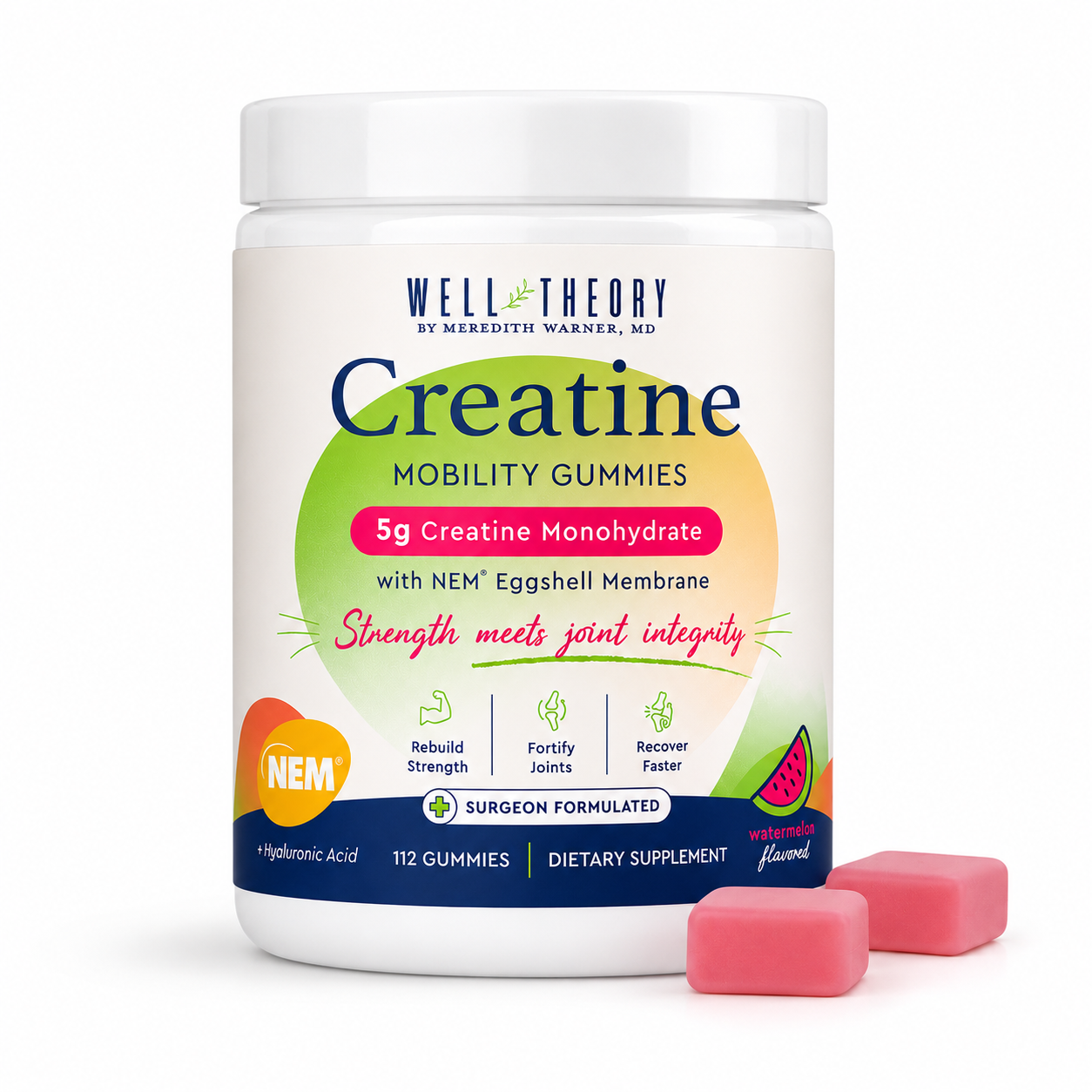
Creatine + NEM Mobility Gummies pair 5 g of creatine monohydrate with 500 mg of NEM eggshell membrane, plus hyaluronic acid and vitamin C, in a four-gummy serving.* Creatine supports strength and training recovery, and the eggshell membrane supplies the raw-material side of the joint routine in the same serving.*
It is the formulation equivalent of the two-part lesson above: load the joint well, then give it the parts list.
Why do strong muscles mean comfortable joints?
Muscles are the joint’s suspension system. When they are strong, they absorb force before it reaches cartilage; when they fatigue, more of every step lands on the joint itself. That is why strength work is joint work, whatever the mirror has to say about it.
- Muscles absorb load first. Well-conditioned hips and thighs distribute force across the joint surface instead of concentrating it in one spot.
- Twice a week is the floor. Two short strength sessions cover the major muscle groups: chair squats, step-ups, wall push-ups, and a band row, with the lowering phase done slowly.
- Creatine pairs with the training. In a 2026 systematic review and meta-analysis of trials in adults over 60, creatine alongside resistance training produced greater gains in strength, muscle mass, and physical function than training alone.
For the full case for keeping muscle through the fifties and beyond, the research-backed playbook is in why muscle fades after 50 and the walk that slows it.
The Bottom Line
What helps with stiff joints is support for all three systems: a tidy inflammatory rhythm, cartilage that gets daily delivery through movement plus raw materials, and muscles strong enough to take the load. Food and walking do most of the work.
Focused formulas fill the gaps: Joint Health Multi for the botanical-and-PEA side of the routine, Creatine + NEM Mobility Gummies for strength and raw materials together, and Tart Cherry Extract for exercise recovery and a healthy inflammatory response after the active days.*
The easiest first step needs no equipment at all: an after-dinner walk puts the compression-and-release cycle on the calendar every evening.
FAQ
What helps with stiff joints in the morning?
Gentle movement first, before demanding anything of the body. Slow range-of-motion exercises, a warm shower, and an easy walk all circulate synovial fluid, which is the system the stiffness is asking for. The first ten minutes are usually the hardest and the fastest to improve.
Is it normal for joints to feel stiff after sitting for a while?
Yes. Stillness lets synovial fluid settle and cartilage lose a little of its temporary plumpness, so creakiness after a long sit is the expected behavior of the system, not a verdict on the joint. Ease of movement returning within a few minutes of walking around is the healthy pattern. Stiffness that persists or worsens deserves a conversation with a qualified professional.
Do supplements for stiff joints work right away?
No supplement built on natural compounds works by morning. They work by being present, day after day, while the systems they support do their slow work. The 90-day window exists because judging a routine at week two tells a person close to nothing about week twelve.
Does exercise make stiff joints worse?
Not when it is dosed sensibly. Systematic reviews of randomized trials report no evidence of cartilage wear from appropriately prescribed exercise, and some measures of joint health improved. The keys are low-impact movement, gradual progression, and consistency rather than intensity.
What foods support joint comfort?
Fatty fish, extra virgin olive oil, berries, leafy greens, legumes, nuts, and colorful vegetables form the core of an anti-inflammatory eating pattern, while limiting refined carbohydrates and excess omega-6-rich processed oils. Eating patterns count more than any single food or single meal.
