

Strong Is the New Thin: Why Muscle Belongs in a Bone-Health Routine
Strong is the new thin because thin does not carry groceries, climb stairs, or give bones a reason to stay useful. Muscle is not decoration. It is daily infrastructure.
This is where the routine gets interesting: strength work, creatine monohydrate, and vitamin D3 all speak to different parts of the same story. One asks the body to adapt. One helps support short bursts of muscle work. One helps the body handle calcium for normal bone mineralization.
Key Takeaways
- Thin is a size goal; strong is a function goal. Bones respond to load, muscles protect everyday independence, and the mirror is a poor measurement tool for either one.
- Creatine + NEM® Mobility Gummies fit this angle because creatine monohydrate supports muscle performance during strength routines, while NEM® is included for joint comfort support.
- Vitamin D3 Gummy belongs beside the strength conversation because vitamin D3 supports calcium absorption and normal bone mineralization.
- The useful promise is not instant transformation. The useful promise is a routine people can repeat: train, recover, get daylight, eat protein, and make the supplement step simple enough to remember.
Why Does Muscle Matter for Bone Health?
Bone is living tissue, not a calcium statue. It is constantly being remodeled in response to the signals around it, including mechanical load from muscle.
- Muscle gives bones a job. A squat, step-up, carry, or band row sends a different message than sitting very still and hoping calcium does all the work.
- Strength is visible in ordinary life. Getting off the floor, lifting a suitcase, and walking with purpose are all small tests that matter more than a dress size.
- The best routine is boring enough to repeat. Two or three strength sessions, daily protein, sunlight when possible, and a supplement step people actually take beats a dramatic plan that lasts nine days.
Muscle is one of the body’s most honest receipts for how a person is aging.

Definition: lean tissue. In body-composition studies, lean tissue can include muscle, water, organs, and other non-fat mass. That is why creatine research has to be read carefully: early lean-mass changes may include water, not only new contractile muscle.
Does Creatine Help Strength Training After 40?
Creatine monohydrate is not new, which is part of its appeal. It has been studied for decades, and the practical mechanism is simple enough to explain without fog.
- Creatine helps replenish phosphocreatine. That system supports short, high-demand efforts like sets of lifting, stairs, and repeated training work.
- The better story is creatine plus loading. A 2021 meta-analysis in older women found creatine paired with resistance training improved measures of muscle strength and muscle mass more than training alone.
- Newer research should be read with restraint. A 2026 middle-aged-adult study reported lean-tissue gains with a higher 10 g/day dose, including a no-prescribed-exercise arm, but that does not make creatine a substitute for strength work.
The point is not “take creatine instead of training.” The point is to make the training routine better supported.
A Daily Gummy That Is Easy to Keep Using
Powder tubs have their place. So do capsules. But the best supplement is often the one that stays simple enough for the countertop, the car, the workday, and the part of the evening where good intentions go missing.
- Creatine monohydrate is the anchor. It is the creatine form with the deepest research base for muscle-performance support.
- NEM® adds joint-comfort logic. Natural eggshell membrane has been studied for joint comfort and stiffness in active adults and postmenopausal women.
- The form reduces friction. A gummy is not magic. It is a compliance tool, and compliance is not a small detail in a 90-day routine.
Creatine + NEM® Mobility Gummies are the main product fit for this article: strength routine support plus joint-comfort support in a daily format.
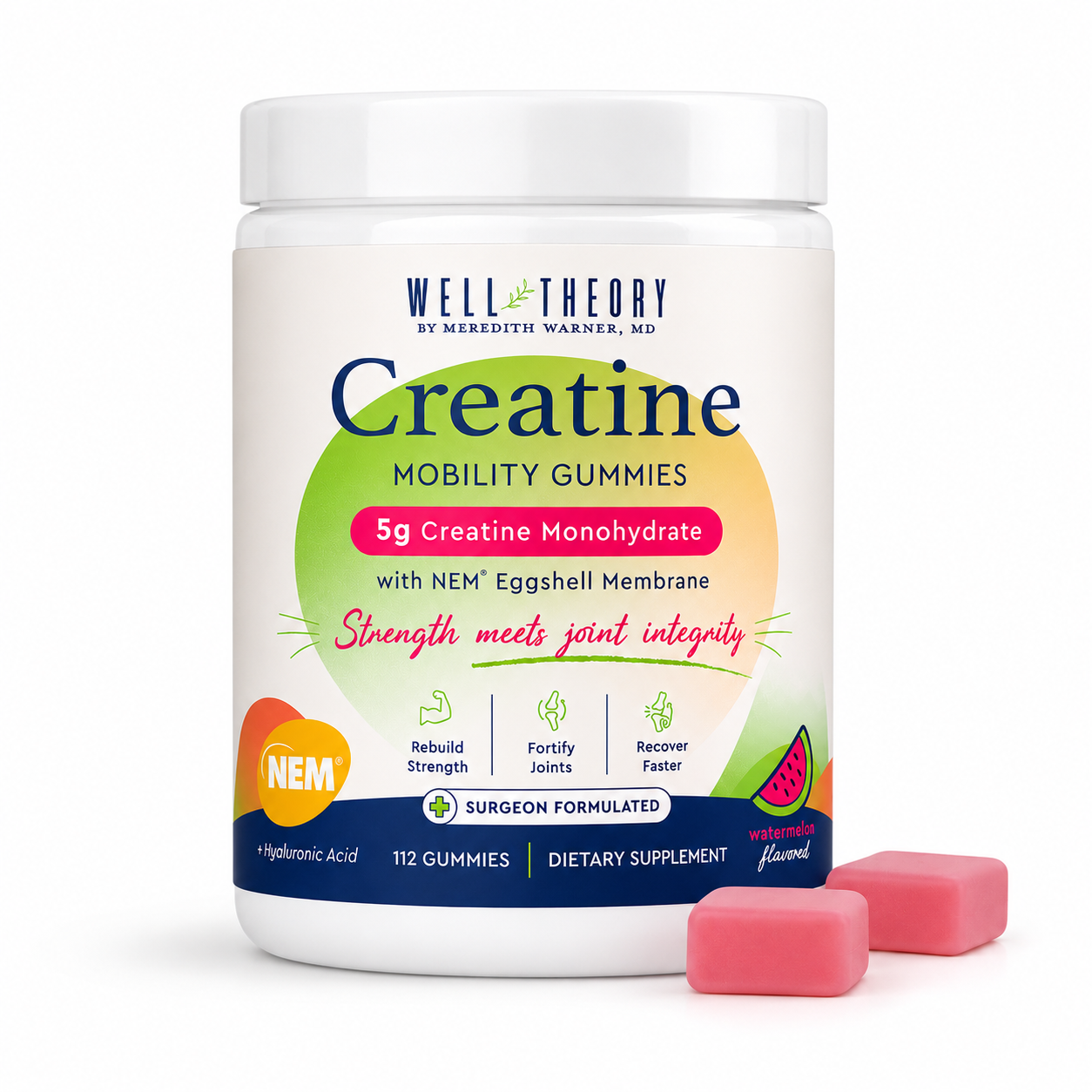
Creatine + NEM® Mobility Gummies: Strength, Joints, & Brain
- Muscle strength: 5 g creatine monohydrate to support muscle strength and power with exercise.*
- Joint comfort: 500 mg NEM eggshell membrane to support joint comfort and flexibility.*
- No scoop: 4 watermelon gummies. 28 servings. Stay hydrated.

80 in stock
Make creatine a gummy habit.*
The scoop stays in the tub. Four watermelon gummies do not.
Creatine + NEM Mobility Gummies are formulated by orthopedic surgeon Dr. Meredith Warner. Each serving is 4 gummies: 5 g creatine monohydrate, 500 mg NEM eggshell membrane, 20 mg hyaluronic acid, and 20 mg vitamin C. Intended to support muscle strength with exercise, joint comfort, and everyday mobility.* Creatine is not only for bodybuilders. This is not a powder, and it is not a 90-day bundle.
- Muscle strength: 5 g creatine monohydrate to support muscle strength and power with exercise.*
- Joint comfort: 500 mg NEM eggshell membrane to support joint comfort and flexibility.*
- No scoop: 4 watermelon gummies. 28 servings. Stay hydrated.
Inside each bottle: 28 servings · 4 gummies per serving · Watermelon flavor. Contains egg. Read the Supplement Facts on this page.
A clear routine. Realistic expectations.
The goal is support for muscle strength with exercise, joint comfort, and everyday mobility.* Take 4 gummies daily. Stay hydrated. Pair with the movement you already do. Dr. Warner's standard is 90 days before you judge; this bottle is 28 servings. If you expect overnight results, please save your money. It does take time to work within the body.
Choose Creatine + NEM Gummies when you want 5 g creatine and 500 mg NEM in a gummy, not a tub of powder.*
*These statements have not been evaluated by the Food and Drug Administration. This product is not intended to diagnose, treat, cure, or prevent any disease.
Dr. Warner's standard is 90 days.
Nutritional supplements do not work the way an as-needed product works. That process takes time, and it only happens with consistent daily use.
This is why Dr. Warner recommends taking any supplement daily for at least 90 days before deciding what it is doing for you. It is the same guidance she gives her patients.
Most people never get there. They buy one month, take it for three weeks, notice nothing dramatic, and stop before the thing they were hoping for ever had a chance to happen.
Sale discounts apply to your first subscription payment only. Renewals are billed at the normal price for your selected subscription tier.
Where Does Vitamin D3 Fit?
Vitamin D3 is quieter than creatine because it does not feel like a workout ingredient. It works in the background, which is exactly why it is easy to forget.
- Vitamin D3 supports calcium absorption. NIH notes that this nutrient helps the body absorb calcium and supports normal bone mineralization.
- It is not a “more is always better” nutrient. The job is sufficiency and consistency, not hero dosing.
- Routine beats drama again. A gummy beside breakfast is less impressive than a 14-step protocol, but it is more likely to happen.
Bone wellness is built from repeated inputs, not one grand gesture.
Can a Vitamin Gummy Be Serious?
A gummy can be serious when the label is serious. The format is not the claim. The formula and the consistency are.
- Each serving lists vitamin D3. The formula is built for bone wellness support.
- B12 gives the formula an everyday-energy angle. That keeps the product from living only in a bone-health drawer.
- The habit is the product experience. The goal is not to feel something dramatic in ten minutes. It is to make the daily step simple enough to repeat.
For the second product fit, Vitamin D3 Gummy supports the bone-wellness side of the strength routine.

Vitamin D3 Gummy: Bone, Mood, Energy Support
- Bone wellness: Vitamin D3 supports bone wellness.*
- Everyday mood: Supports everyday mood.*
- Energy support: Vitamin B12 supports everyday energy.*
- Magnesium: 10 mg magnesium citrate is a modest amount listed with D3 and B12. It is not a standalone magnesium supplement.

300 in stock
Make vitamin D part of the plan.*
The gym gets a slot. Vitamin D is the one that slips.
The Well Theory Vitamin D3 Gummies bring bone wellness, everyday mood, and energy support into a vegan gummy.* Formulated by orthopedic surgeon Dr. Meredith Warner. Each serving lists 4,000 IU vitamin D3 (cholecalciferol), 1,200 mcg vitamin B12 (methylcobalamin), and 10 mg magnesium (as magnesium citrate).
- Bone wellness: Vitamin D3 supports bone wellness.*
- Everyday mood: Supports everyday mood.*
- Energy support: Vitamin B12 supports everyday energy.*
- Magnesium: 10 mg magnesium citrate is a modest amount listed with D3 and B12. It is not a standalone magnesium supplement.
Inside each bottle: 30 vegan gummies. Read the Supplement Facts on this page for serving size.
A clear routine. Realistic expectations.
The goal is support for bone wellness, everyday mood, and energy.* Pay attention to how your days feel over 90 days of daily use. Responses vary; we do not promise a particular mood after one gummy. If you expect overnight results, please save your money. It does take time to work within the body.
Choose Vitamin D3 Gummies when you want D3, B12, and a listed magnesium amount in a daily gummy.*
*These statements have not been evaluated by the Food and Drug Administration. This product is not intended to diagnose, treat, cure, or prevent any disease.
Dr. Warner's standard is 90 days.
Nutritional supplements do not work the way an as-needed product works. That process takes time, and it only happens with consistent daily use.
This is why Dr. Warner recommends taking any supplement daily for at least 90 days before deciding what it is doing for you. It is the same guidance she gives her patients.
Most people never get there. They buy one month, take it for three weeks, notice nothing dramatic, and stop before the thing they were hoping for ever had a chance to happen.
Sale discounts apply to your first subscription payment only. Renewals are billed at the normal price for your selected subscription tier.
What Should the Routine Look Like?
The most useful plan is not glamorous. It is a short list that keeps showing up.
- Lift something on purpose. Bands, dumbbells, machines, or bodyweight work all count when they are progressive and repeatable.
- Eat enough protein. Muscle cannot be built from vibes and a sparkling water.
- Make the daily supplement step obvious. Keep it near an existing habit instead of relying on memory.
- Track capacity, not punishment. More reps, steadier stairs, better balance, and consistent workouts are better signals than scale obsession.

The Bottom Line
Strong is the new thin because strength is measurable in life, not just in photos.
- Build the article’s promise around function. Carrying, climbing, lifting, walking, and recovering are stronger desires than shrinking.
- Use creatine as the mechanism story. Phosphocreatine and repeat training effort are more believable than vague “anti-aging” language.
- Use vitamin D3 as the foundation story. Calcium absorption and normal bone mineralization make sense beside a bone-health routine.
- Keep expectations adult. Supplements support the routine. They do not replace the work.
For the practical weekly version, read The Strength Routine Your Bones Notice.
FAQ
Is strong the new thin after 40?
For a bone-health routine, strong is a more useful target than thin. Muscle supports everyday movement, strength training gives bones a reason to stay active, and nutrients help supply the routine around that work.
Does creatine monohydrate support strength training after 40?
Creatine monohydrate has been studied with resistance training in older women and middle-aged adults. The strongest everyday use is support for training capacity, lean-mass routines, and muscle performance, not a replacement for exercise.
Why does vitamin D3 belong in a strength routine?
Vitamin D3 supports calcium absorption and normal bone mineralization. That makes it part of the background plan for bone wellness, especially when the routine also includes protein, resistance work, daylight, and consistency.
Can gummies be part of a serious wellness routine?
Yes, if the formula is clear and the routine is consistent. A gummy format does not make the ingredient less serious; the question is whether the label, dose, and claim language are realistic.
Sources
- Efficacy of Creatine Supplementation Combined with Resistance Training on Muscle Strength and Muscle Mass in Older Females: A Systematic Review and Meta-Analysis.
- Effects of creatine supplementation with and without exercise and diet intervention on body composition, cognitive function, and markers of health in middle-aged and older adults.
- Beneficial effects of natural eggshell membrane versus placebo in exercise-induced joint pain, stiffness, and cartilage turnover in healthy, postmenopausal women.
- No effect of creatine monohydrate supplementation on inflammatory and cartilage degradation biomarkers in individuals with knee osteoarthritis.
- NIH Office of Dietary Supplements: vitamin D3 fact sheet for health professionals
- The Well Theory Creatine + NEM® Mobility Gummies product page
- The Well Theory D3 gummy product page
