

Should Women Take Creatine? What Creatine Supports
Yes, women can take creatine, and the strongest case is practical: creatine supports muscle strength and cellular energy during short, demanding efforts. Research in women is growing, while the clearest routine remains simple, consistent creatine monohydrate paired with regular resistance exercise.
By Dr. Meredith Warner, MD, board-certified orthopedic surgeon. Reviewed October 19, 2026.
Key Takeaways
- Creatine is not gender-specific: Women use the same creatine-phosphate energy system in muscle, and daily creatine can support strength and power with exercise.
- ATP explains the appeal: Creatine helps recycle ATP, the molecule muscles use for quick bursts of work.
- Water in muscle is expected: Creatine can increase water held inside muscle cells, which is different from generalized puffiness.
- A practical serving: The evidence-based routine commonly discussed for healthy adults is 3 to 5 grams daily, with or without a loading phase.
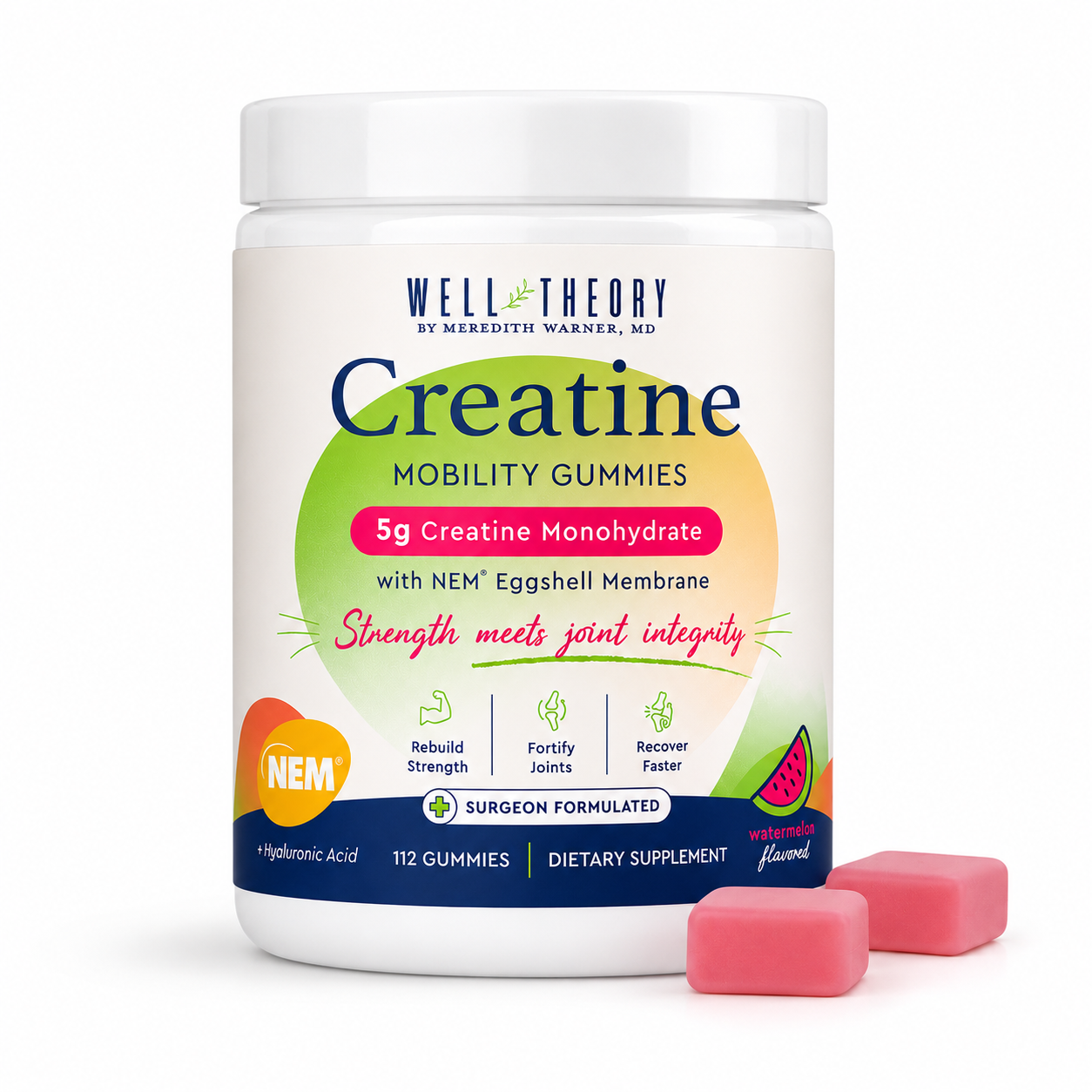
- A gummy option: Creatine + NEM Mobility Gummies provide 5 g creatine monohydrate per four-gummy serving, plus NEM, hyaluronic acid, and vitamin C.
Watch Dr. Warner Answer the Question

Should Women Take Creatine Every Day?
For most healthy adults who choose to supplement, daily use is the straightforward approach because muscle creatine stores build through regular intake. Timing is less important than making the habit fit the routine, whether that means breakfast, after training, or alongside dinner.
The useful question is not whether creatine is “for women.” It is whether the serving, format, and daily habit support the kind of movement a person wants to keep doing.
Definition: What Is ATP?
ATP, or adenosine triphosphate, is the cell’s immediately usable energy currency. During a short effort such as lifting a weight or standing from a low chair, muscle cells need to remake ATP quickly. Creatine helps support that rapid recycling through the phosphocreatine system.
How Does Creatine Support Strength?
Creatine is stored partly as phosphocreatine in muscle. When a movement demands quick energy, phosphocreatine helps regenerate ATP so the muscle can keep working for another brief burst. That mechanism is why creatine fits resistance training, repeated climbs, and other stop-and-start activities better than long, steady endurance work.
- Short efforts: Creatine supports the energy system used for repeated sets, brisk uphill work, and other high-intensity intervals.
- Training quality: When the energy system is supported, a person may be able to complete more useful work during a session.
- Strength over time: The supplement does not replace training. The meaningful result comes from pairing the routine with progressive movement.
Creatine supports the work of training; it does not turn a supplement into a training plan. The NIH Office of Dietary Supplements describes creatine as most useful for repeated, short bursts of high-intensity activity.
Does Creatine Make Women Bulky?
No, creatine does not automatically make women bulky. It can increase body water, primarily within muscle, and that change is not the same as generalized swelling or a sudden change in body shape. Muscle gain still depends on training stimulus, food intake, recovery, genetics, and time.
- Muscle water: An increase in intracellular water can be part of how muscle stores creatine.
- Muscle tissue: Changes in strength and lean tissue are training adaptations, not an instant effect of taking one serving.
- Expectation: A scale change does not explain where water is held or what a person can do in the gym.
What Is the Best Creatine Routine for Women?
The best routine is the one that supplies a consistent amount and is easy enough to keep doing on a normal weekday. Creatine monohydrate is the most studied form, and a daily 3 to 5 gram routine is commonly used without requiring a loading phase.
- Choose the form: Creatine monohydrate has the deepest research base and is the form used in the TWT gummy.
- Choose the serving: A four-gummy serving supplies 5 g of creatine monohydrate, plus 500 mg NEM eggshell membrane, 20 mg hyaluronic acid, and 20 mg vitamin C.
- Choose the cue: Attach the serving to a meal or movement habit that already happens most days.
- Stay hydrated: Fluids support ordinary daily physiology and make the routine easier to tolerate.
The formula is designed for people who prefer a measured gummy to a scoop. Creatine + NEM Mobility Gummies are intended to support muscle strength with exercise, joint comfort, and everyday mobility, with the product serving as a convenience format rather than a replacement for movement.
Can Creatine Support Cognitive Wellness Too?
Creatine is also present in the brain, which has its own high and fluctuating energy demands. Research on cognition is more mixed than the research on short-burst exercise performance, so the responsible takeaway is that creatine has a plausible energy role in the brain, while cognitive benefits should not be promised as a universal result.
- What is established: Creatine participates in energy storage and recycling in tissues with changing energy demands.
- What is still developing: Studies in women and older adults are useful, but outcomes vary by dose, population, baseline diet, and test.
- What to expect: The clearest reason to consider creatine remains support for strength and muscle function with exercise.
For a related look at how creatine fits a mobility-focused routine, read why creatine after 40 can support joint-friendly strength goals. For the movement side of the equation, see these functional strength and balance exercises.
The Bottom Line
Women can take creatine, and the best-supported reason is to support muscle strength, power, and cellular energy during exercise. A consistent daily serving of creatine monohydrate, paired with resistance training or other purposeful movement, is a reasonable structure/function routine for healthy adults.
- Start with the mechanism: Creatine supports rapid ATP recycling in muscle.
- Keep the promise narrow: Strength and exercise support are clearer than universal claims about cognition or body composition.
- Make the format practical: Creatine + NEM Mobility Gummies offer a measured gummy serving for people who prefer that format.
Creatine Questions Women Ask
Should women take creatine?
Women can take creatine, and research supports its role in muscle energy and exercise performance. Individual needs vary, so people with medical conditions or medication questions should ask a qualified healthcare professional.
Does creatine make women gain fat?
Creatine does not directly add body fat. It can increase water held inside muscle cells, while changes in muscle tissue and body composition depend on training, food intake, recovery, and time.
How much creatine should a woman take?
A commonly used daily routine for healthy adults is 3 to 5 grams of creatine monohydrate. The correct choice depends on the person and the product, so follow the product label and professional guidance when relevant.
Does creatine help with strength training?
Creatine supports the phosphocreatine system that helps muscles regenerate ATP during short, intense efforts. Studies generally find the most practical relevance when creatine is paired with resistance exercise.
Sources
- Dietary Supplements for Exercise and Athletic Performance, NIH Office of Dietary Supplements
- Creatine Supplementation in Women’s Health: A Lifespan Perspective
- Efficacy of Creatine Supplementation Combined with Resistance Training on Muscle Strength and Muscle Mass in Older Females: A Systematic Review and Meta-Analysis
- Creatine + NEM Mobility Gummies Supplement Facts and product information
